
Magoffin Parole and Probation
Parole and probation both allow a person to live in the community under rules, but they begin in different ways. Parole is a conditional release from a prison sentence through Kentucky's parole process. Probation is supervision ordered by a court, often instead of incarceration or after a short custodial term. The Kentucky Department of Corrections Division of Probation and Parole administers both forms of community supervision. That shared administrator does not make the legal statuses interchangeable.
A person released from Big Sandy Regional Detention Center may have no supervision, may begin court-ordered probation, may transfer into KDOC custody, or may already have a state parole matter. A missing jail-roster card proves none of these outcomes. The court order and the person's Kentucky Offender Online Lookup record provide better evidence.
| Question | Parole | Probation |
|---|---|---|
| How it begins | Conditional release within a prison sentence | Order entered by a court |
| Who administers it | KDOC Division of Probation and Parole | KDOC Division of Probation and Parole |
| Best record clues | KOOL parole table, status, and Board action | KOOL supervision status and court probation order |
| How it ends | Discharge, sentence expiration, or another formal action | Completion, discharge, revocation, or another court action |
- Discharge
- A formal end to a sentence or supervision obligation.
- Absconder
- A person alleged to have stopped required contact with supervision.
- Revocation
- A formal action that can withdraw probation or parole after the required process.
- Detainer
- A request or hold from another authority that may affect custody or release.
Verify Magoffin Post-Release Supervision
The official public lead is Kentucky Offender Online Lookup, known as KOOL. Begin with a broad name search and compare more than the name. The system may show a PID or DOC number, status, location, county of supervision, convictions, aliases, sentence dates, and a parole-information table. “County of Supervision: Magoffin” points to a community assignment. It does not prove the person was booked at BSRDC or physically reports inside Magoffin County.
- Search the surname with a first name or initial, then narrow only if several records appear.
- Open the likely record and compare the PID or DOC number, age, aliases, conviction county, and offense details.
- Record the displayed supervision status, county, location, and retrieval date.
- Use the listed location to identify the likely KDOC office rather than assuming an office from residence alone.
- Call District 11 with the PID or DOC number and ask what current public assignment information can be confirmed.
KOOL data refreshes during the day, but recent entries can still be revised. A state record also may not exist for a short BSRDC-only detention. When KOOL and a court order conflict, ask the agency that created the disputed field to explain or correct it. The broader Magoffin County released inmate search path identifies the separate jail, court, VINE, and state-record channels.
VINELink serves a different role. Kentucky VINE can report a custody event or send a notice when a participating jail or KDOC transmits a change. It does not provide the full supervision file, and a release notice does not state whether probation or parole followed. The Kentucky State Police registry is narrower still. It applies only to people required to register under the governing law and is not a general list of people on supervision. For a Magoffin County parole or probation question, KOOL, the court order, and District 11 remain the relevant chain.
Magoffin Supervision Office Assignment
Magoffin County belongs to KDOC's Eastern Region, District 11. The official district page covers Floyd, Johnson, Knott, Letcher, Magoffin, Martin, Perry, and Pike counties. It lists headquarters in Pikeville and a Johnson County satellite in Paintsville, but no Magoffin-specific satellite. It also gives no universal walk-in rule, office hours, or first-report process. The correct office must be confirmed from the person's KOOL location and by phone.
KDOC Probation and Parole District 11
Headquarters:
172 Division Street, Suite 336
Pikeville, KY 41501
Phone: 606-433-7776
Fax: 606-433-7012
Johnson County satellite:
708 S. Mayo Trail
Paintsville, KY 41240
Phone: 606-788-7055
Fax: 606-789-5197
The KDOC central Probation and Parole contact number is 502-782-2277. Separate contacts are published for interstate-compact cases. An office may limit person-specific details, so a public web result should be treated as a lead for a precise call, not a promise that every supervision fact will be disclosed.
Before calling, gather the full name, PID or DOC number, KOOL location, and date the record was viewed. Ask whether the displayed office is the correct public contact and whether the status is still active. Do not arrive at the Paintsville satellite based only on its proximity to Magoffin County. The official page does not say all Magoffin cases report there, and the assigned officer or reporting method may differ.
The official District 11 page shows the regional structure used for Magoffin County supervision. The capture below preserves that office context.
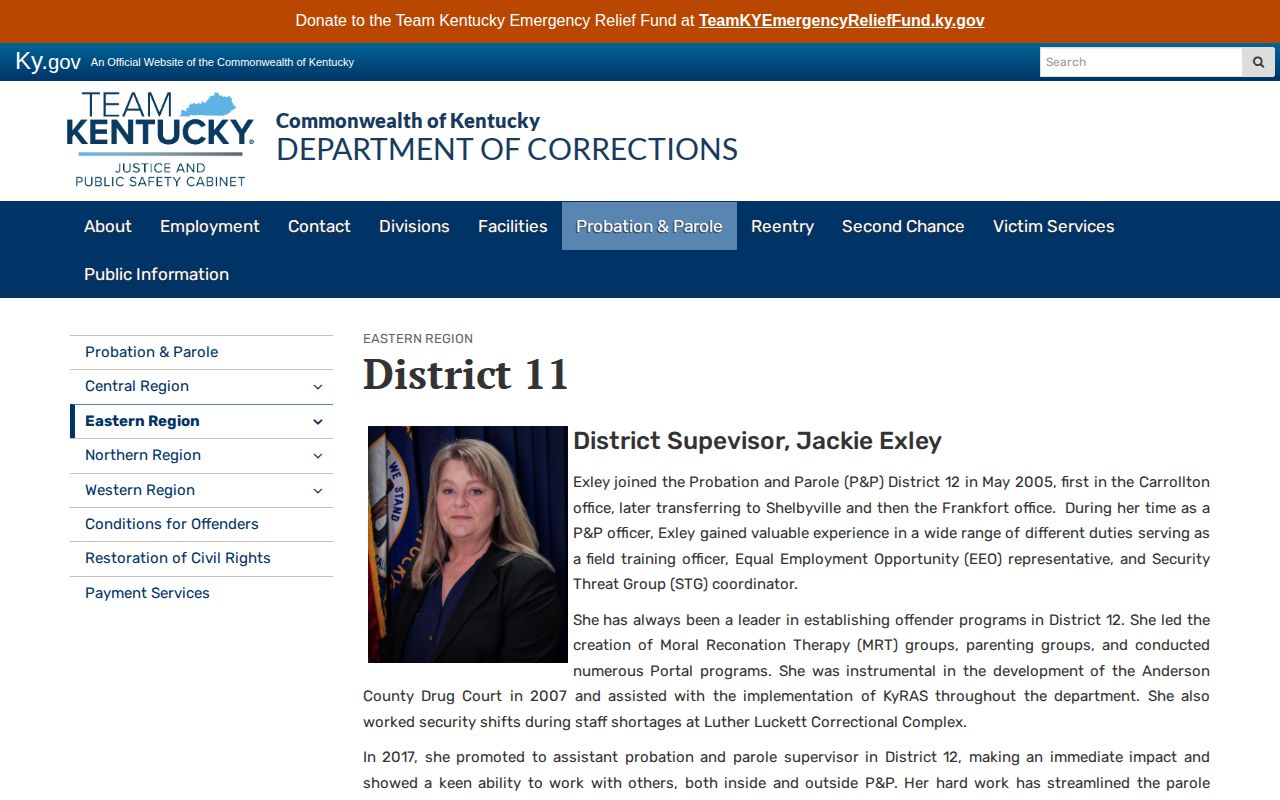
Use the current page and a KOOL location together because regional coverage alone does not assign one person to a specific reporting site.
Magoffin Supervision and Absconders
No official Magoffin County warrant or absconder list was verified. KOOL is the relevant statewide public lead because its advanced form offers supervision and escape or abscond date filters, and results can display an “ABSCONDED” banner. That label means the system reports an alleged failure to maintain required supervision contact. It is not a new conviction, and it does not by itself prove that the person has been arrested again.
Conditions vary with the order and case. They may address reporting, approved travel, treatment, fees, or conduct, but no one set should be assumed for all Magoffin County cases. A suspected violation can lead to investigation and formal action. Parole revocation and probation revocation follow different legal paths, and a notation in a public database is not the final order.
Verify the date. Record when the KOOL status was viewed, then contact District 11 before treating an absconder or location label as current.
Magoffin Parole Action Records
The Kentucky Parole Board publishes monthly schedules and updates them on Monday mornings. Eligibility hearings occur weekly. A schedule can list the hearing date, time, location, offender name, DOC number, and eligibility month. It shows that a review is planned, not that parole was granted or that physical release has occurred. A hearing may occur before the actual eligibility date.
KOOL supplies the more useful person-specific public result path. Its Parole Information table can show a hearing date, action, months deferred, next eligibility date, and proposed release date. “Deferred” means the Board will consider the matter later. A denial or serve-out decision does not authorize release. Even a proposed date still requires processing and a later custody-status change.
The Parole Board statutes and regulations page gathers the governing material for those actions.
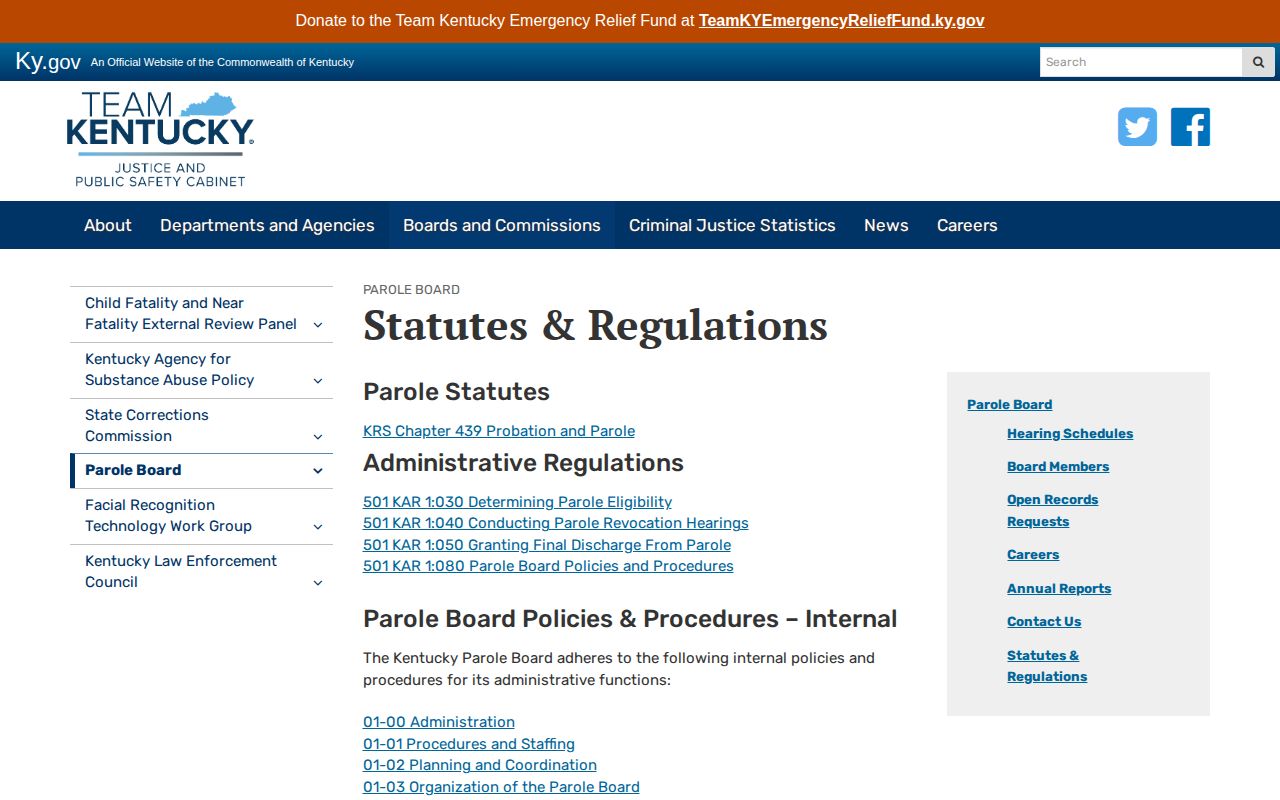
The source helps distinguish a legal eligibility rule from a KOOL status field and from the later event of leaving custody.
Magoffin Release Reentry Resources
BSRDC and KDOC document two different stages. The regional jail lists GED, work release, church meetings, Moral Reconation Therapy, and other programs for people in custody. Those programs do not promise a placement after release. KDOC separately publishes a Magoffin community-resource manual and a current District 11 manual for community navigation after custody.
The current District 11 resource manual is the better starting point for regional service contacts. Entries and eligibility can change. Confirm a service directly, and ask the assigned officer how any appointment fits the person's supervision plan. This keeps program access distinct from formal reporting duties.
Note: A BSRDC program listing describes in-custody offerings, while the KDOC manuals support separate planning after a Magoffin County release.
Correct Magoffin Release Records
BSRDC says it will try to verify and correct an inmate-record error when notified. Because its JailTracker record belongs to the regional system, send a suspected booking, movement, release-time, or release-type error to BSRDC with precise identifiers. Do not assume the Magoffin Sheriff controls that page. Keep a screenshot, note the retrieval time, and ask for the underlying custody-event record when the disputed field matters.
KDOC is the correct route for a KOOL status, sentence, or supervision field. The Magoffin Circuit Court Clerk handles the court docket and orders. A correction request should identify the exact field, record, person, and source. Comparing records is vital because an order authorizing release can precede the mechanical departure time recorded by the jail.
Magoffin Supervision Discharge
Supervision ends through a formal event, not merely because a person stops appearing at a jail. The event may be discharge, sentence expiration, completion of probation, a new court order, revocation, or another authorized action. KOOL may retain a state record after active supervision ends. Its status and sentence fields should be read with the court or agency record that created the change.
For a precise record, use the PID or DOC number and ask KDOC for the existing supervision or discharge document. Kentucky's open-records framework applies to public-agency records subject to exemptions, redactions, and agency procedures. A request should seek a named record rather than ask the agency to write a new explanation. Confirm any disputed end date with the responsible office.
KRS Chapter 439 contains much of Kentucky's parole and mandatory-reentry framework, while the judgment controls probation in the individual case. If the question concerns a parole hearing, compare the Board schedule with KOOL's later action field. If it concerns probation completion, obtain the court order or KDOC discharge record. This source-by-source method avoids treating a stale location, an old hearing entry, or the end of a jail booking as proof that all supervision has ended.